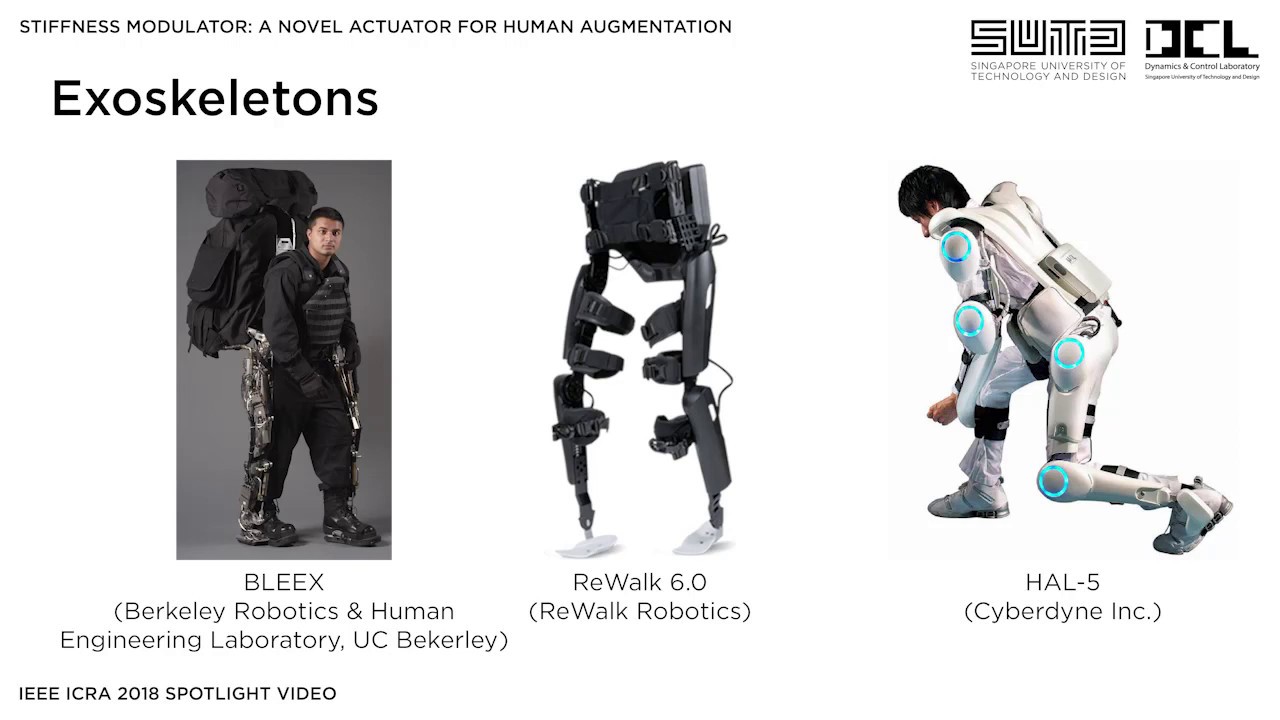
Mechanically adaptive robot exoskeletons to improve human mobility
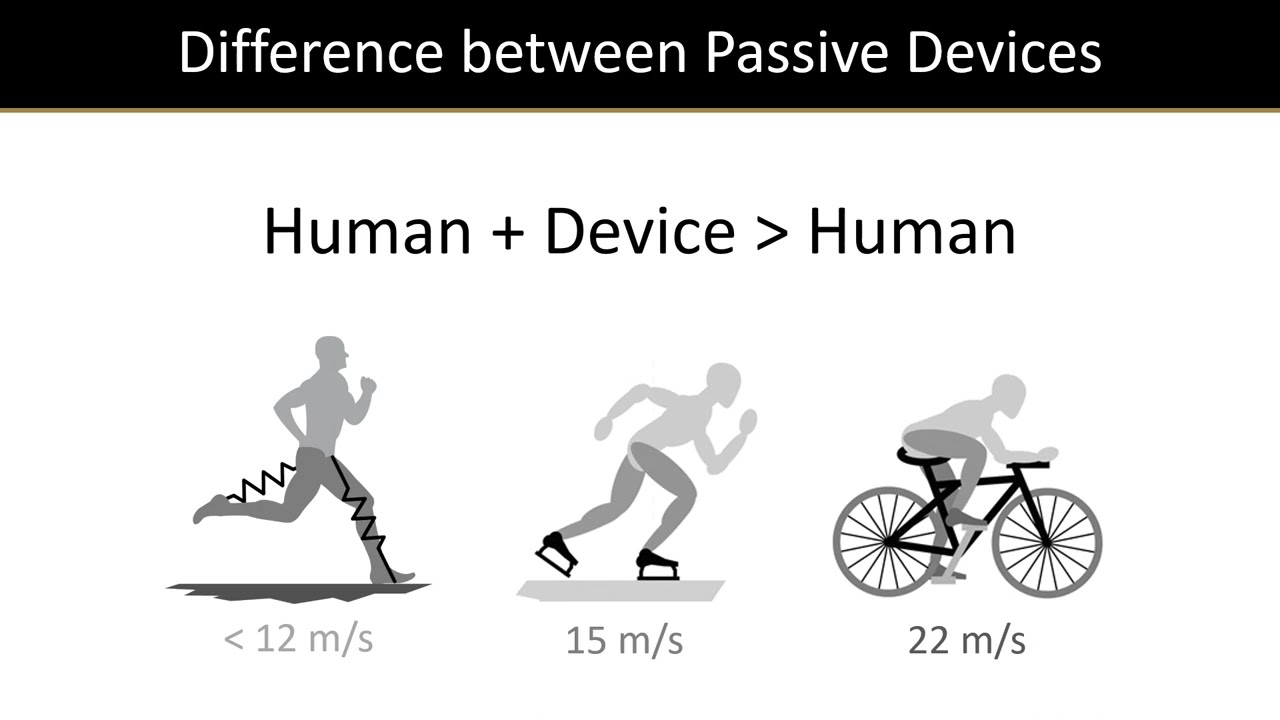
A bicycle has no motor, yet a person on a bicycle travels much farther and faster than on foot. This research develops the theory of robot exoskeletons that work in the same spirit: unpowered devices, or devices driven by small actuators such as a small electric motor, that give a person capabilities beyond those of an unassisted human, to an extent previously thought to require large powered actuators.
These exoskeletons go beyond familiar passive devices such as the bicycle: they contain springs of controllable stiffness, which store energy under active control. In such a spring, the energy stored is no longer tied to how far the spring is compressed. This new capability could advance both human and robot mobility.
Running with a variable stiffness spring leg
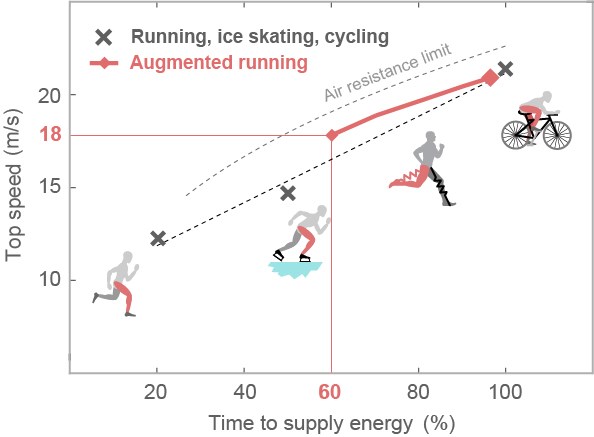
The top speeds of running, ice skating, and cycling follow the time the legs have to supply energy, as the figure below shows. In natural running, the legs supply energy only while the foot is on the ground, about 20% of the time. With a variable stiffness spring leg, a person could in theory supply energy during up to 96% of each step. Even if energy were supplied during only 60% of each step, the theoretical model predicts a top speed of 18 m/s, about 50% above the top speed of natural running (12.3 m/s).
- How to Run 50% Faster without External EnergyA. Sutrisno and D. J. BraunScience Advances, vol. 6, no. 13, Art. no. eaay1950, 2020
@article{Sutrisno2020,
  author  = {A. Sutrisno and D. J. Braun},
  title   = {How to Run 50\% Faster without External Energy},
  journal = SA,
  volume  = {6},
  number  = {13},
  pages   = {eaay1950},
  year    = {2020},
  doi     = {10.1126/sciadv.aay1950}
}
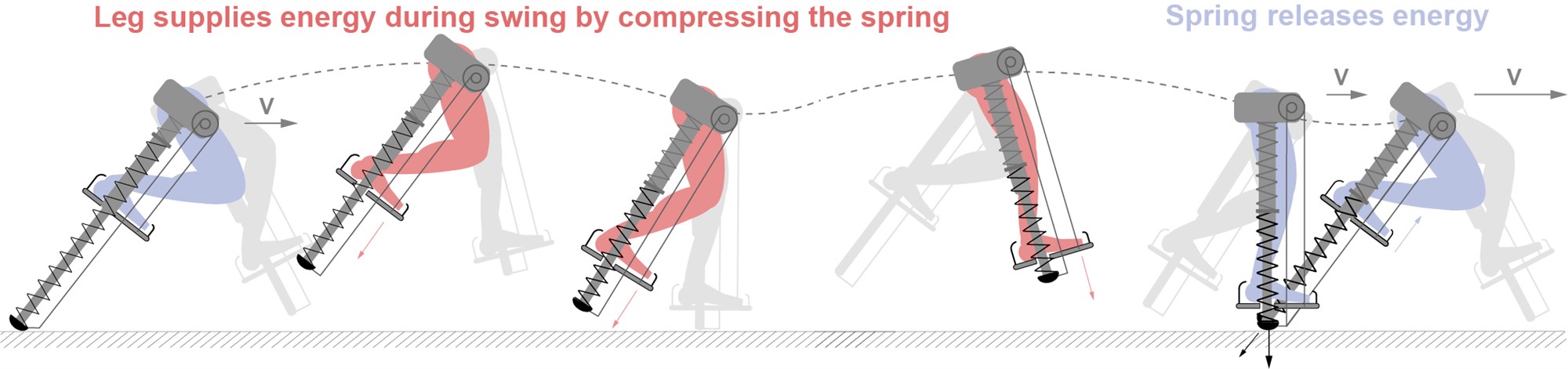
The figure below shows how augmented running works: the person compresses the spring while the leg is in the air, and the spring releases the stored energy when the leg touches the ground.
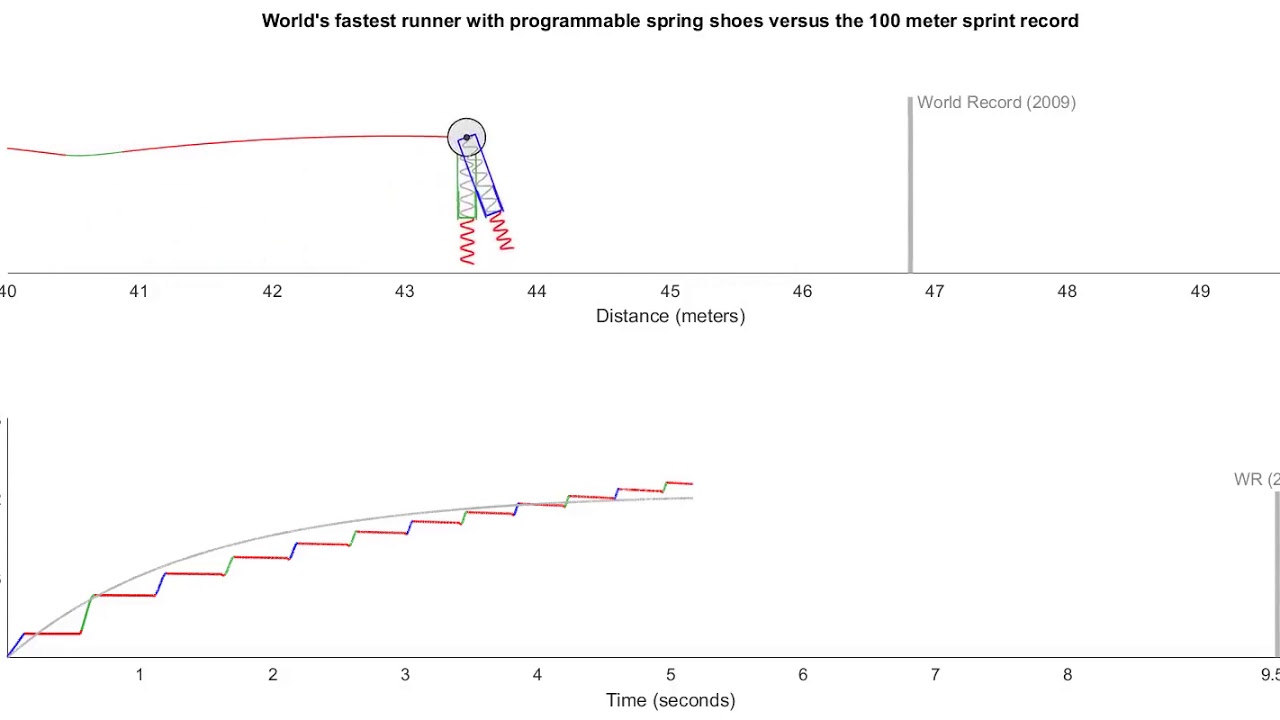
The video below shows a thought experiment: a 100-meter race in which a world-class athlete wearing the variable stiffness spring leg exoskeleton races against the 9.58-second world record set by the Jamaican sprinter Usain Bolt in 2009.
Rethinking assistive robotics with floating spring legs
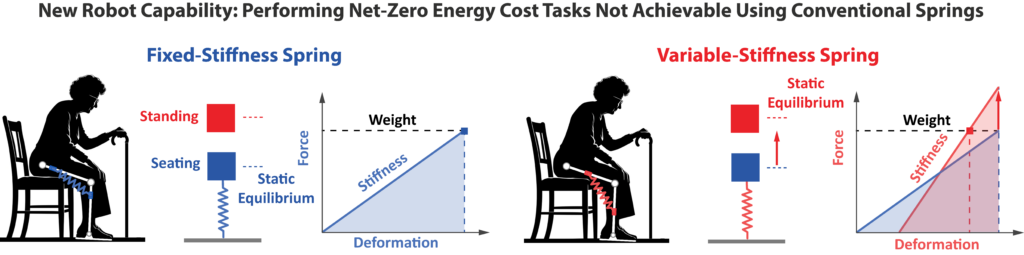
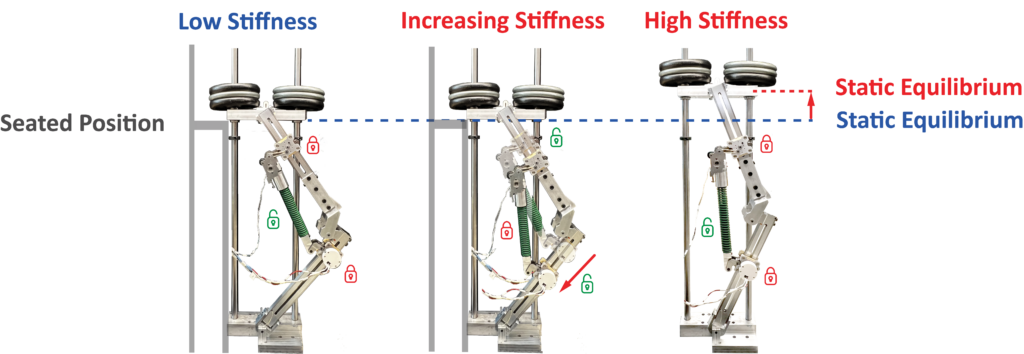
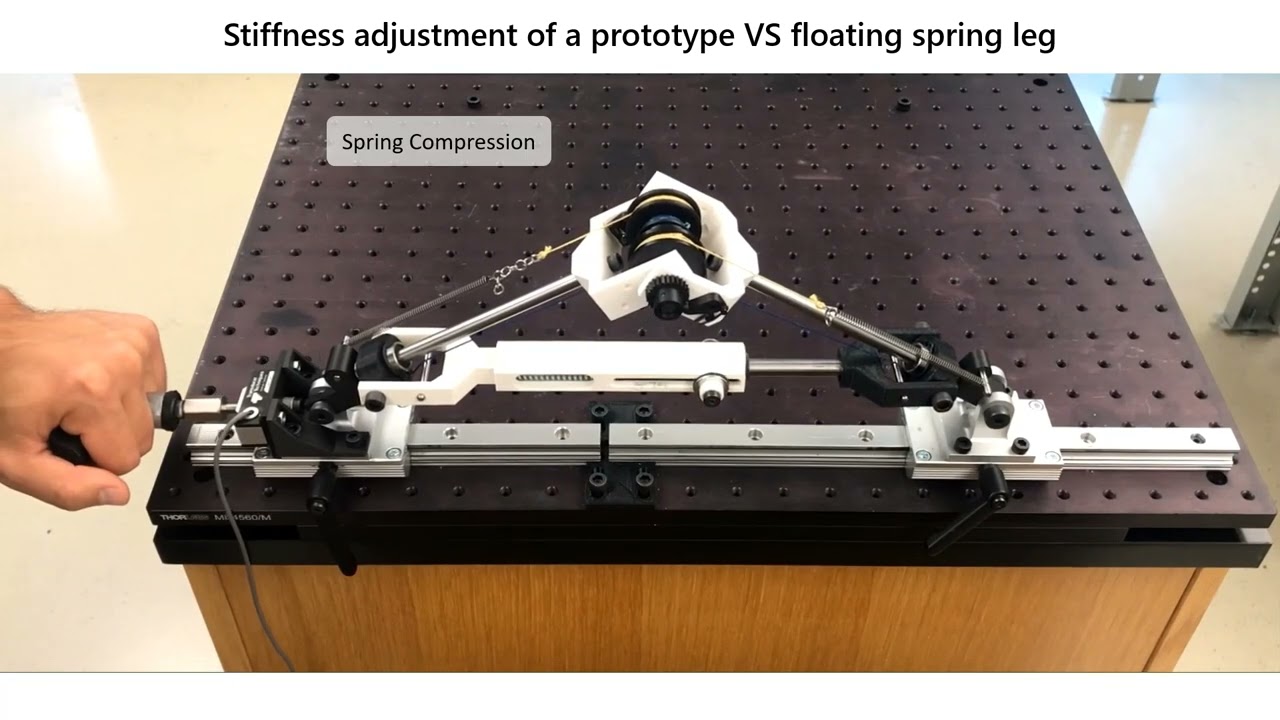
An ordinary spring delivers more force only when it is compressed further. The floating spring leg is a variable stiffness mechanism that changes stiffness while conserving energy. In a simulated sit-to-stand task, the leg stores energy at low stiffness and then switches to high stiffness to amplify the force: a task performed at net-zero energy cost that is not possible with fixed-stiffness springs. Possible uses range from assistive devices for older adults to industrial robots.
- Variable Stiffness Floating Spring Leg: Performing Net-Zero Energy Cost Tasks Not Achievable Using Fixed Stiffness SpringsS. Y. Kim and D. J. BraunIEEE Robotics and Automation Letters, vol. 8, no. 9, pp. 5400–5407, 2023
@article{Kim2023,
  author  = {S. Y. Kim and D. J. Braun},
  title   = {Variable Stiffness Floating Spring Leg: Performing Net-Zero Energy Cost Tasks Not Achievable Using Fixed Stiffness Springs},
  journal = IEEEral,
  volume  = {8},
  number  = {9},
  pages   = {5400--5407},
  year    = {2023},
  doi     = {10.1109/LRA.2023.3292584}
}

Customizing assistance with variable stiffness springs
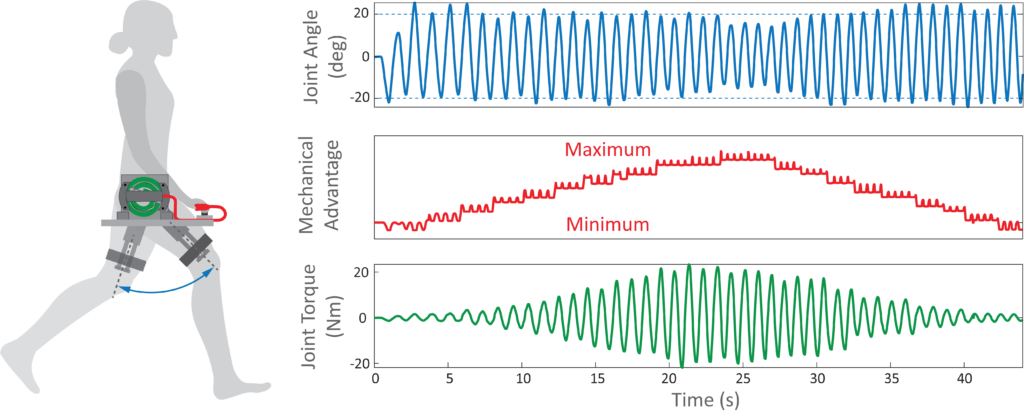
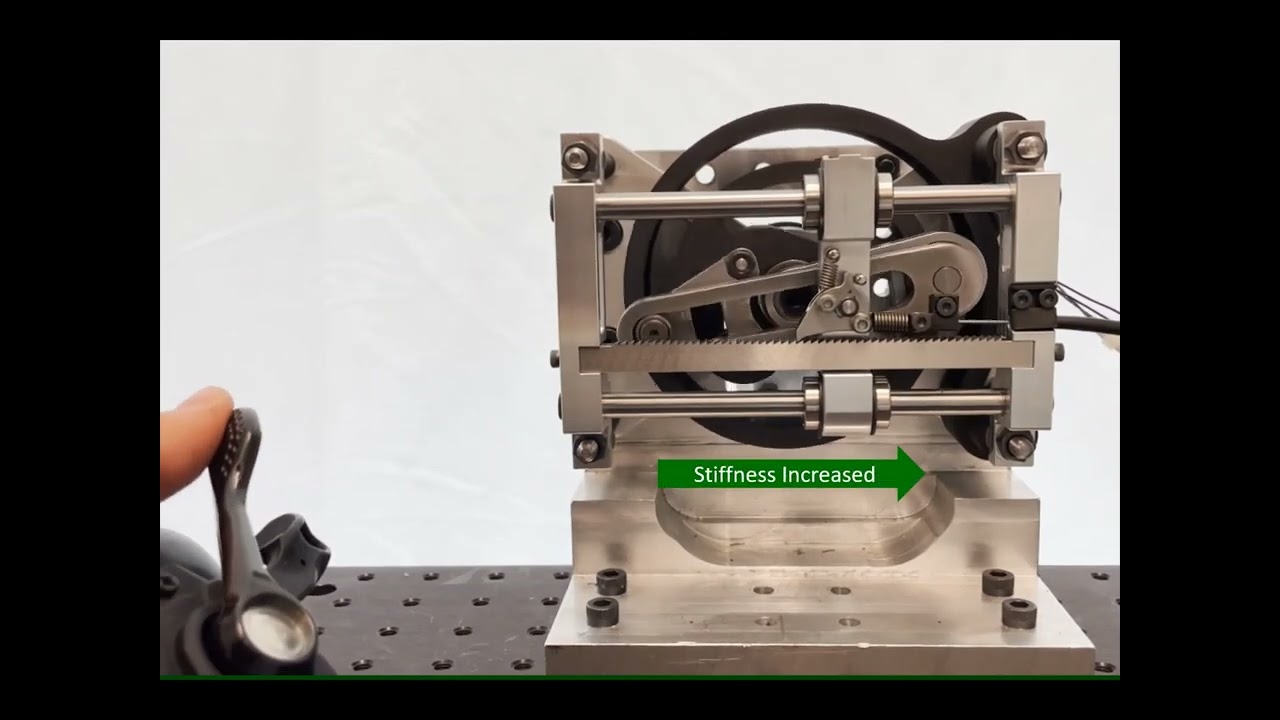
This robot joint lets the user adjust the stiffness, much like shifting gears on a bicycle, to suit different tasks such as walking or running. In a leg swing experiment, the hip stiffness was adjusted smoothly during continuous leg motion. Possible uses include prostheses and robotic exoskeletons that adapt to each activity.
- Design of a Variable Stiffness Spring with Human-Selectable StiffnessC. W. Mathews and D. J. BraunIEEE International Conference on Robotics and Automation, pp. 7385–7390, 2023
@inproceedings{Mathews2023conf,
  author    = {C. W. Mathews and D. J. Braun},
  title     = {Design of a Variable Stiffness Spring with Human-Selectable Stiffness},
  booktitle = IEEEicra,
  pages     = {7385--7390},
  address   = {London, United Kingdom},
  month     = {May},
  year      = {2023},
  doi       = {10.1109/ICRA48891.2023.10161305}
}
Energy accumulation via repeated squatting
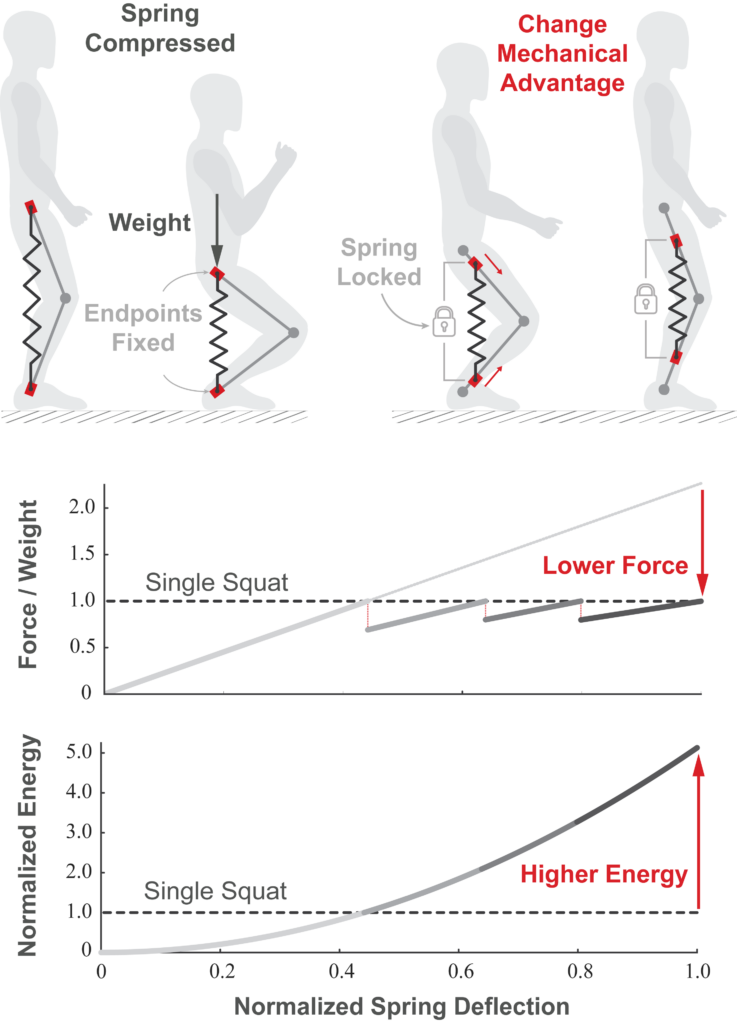
An ordinary spring needs a large force to store a large amount of energy. This variable stiffness spring removes that link: the energy stored no longer depends on the maximum force applied, so small, repeated forces can store a large amount of energy. An assistive robotic leg demonstrates the idea by accumulating energy as the user performs repeated squats. Possible uses include assistive devices and robotic exoskeletons.
- Novel Spring Mechanism Enables Iterative Energy Accumulation under Force and Deformation ConstraintsC. Dempsey and D. J. BraunIEEE International Conference on Robotics and Automation, pp. 7391–7397, 2023
@inproceedings{Dempsey2023conf,
  author    = {C. Dempsey and D. J. Braun},
  title     = {Novel Spring Mechanism Enables Iterative Energy Accumulation under Force and Deformation Constraints},
  booktitle = IEEEicra,
  pages     = {7391--7397},
  address   = {London, United Kingdom},
  month     = {May},
  year      = {2023},
  doi       = {10.1109/ICRA48891.2023.10161577}
}
Walking with a variable stiffness spring leg
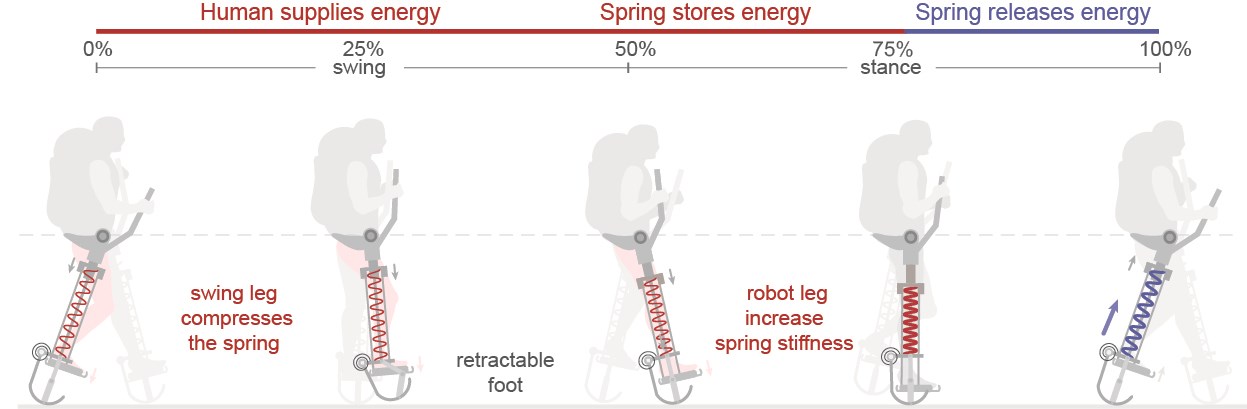
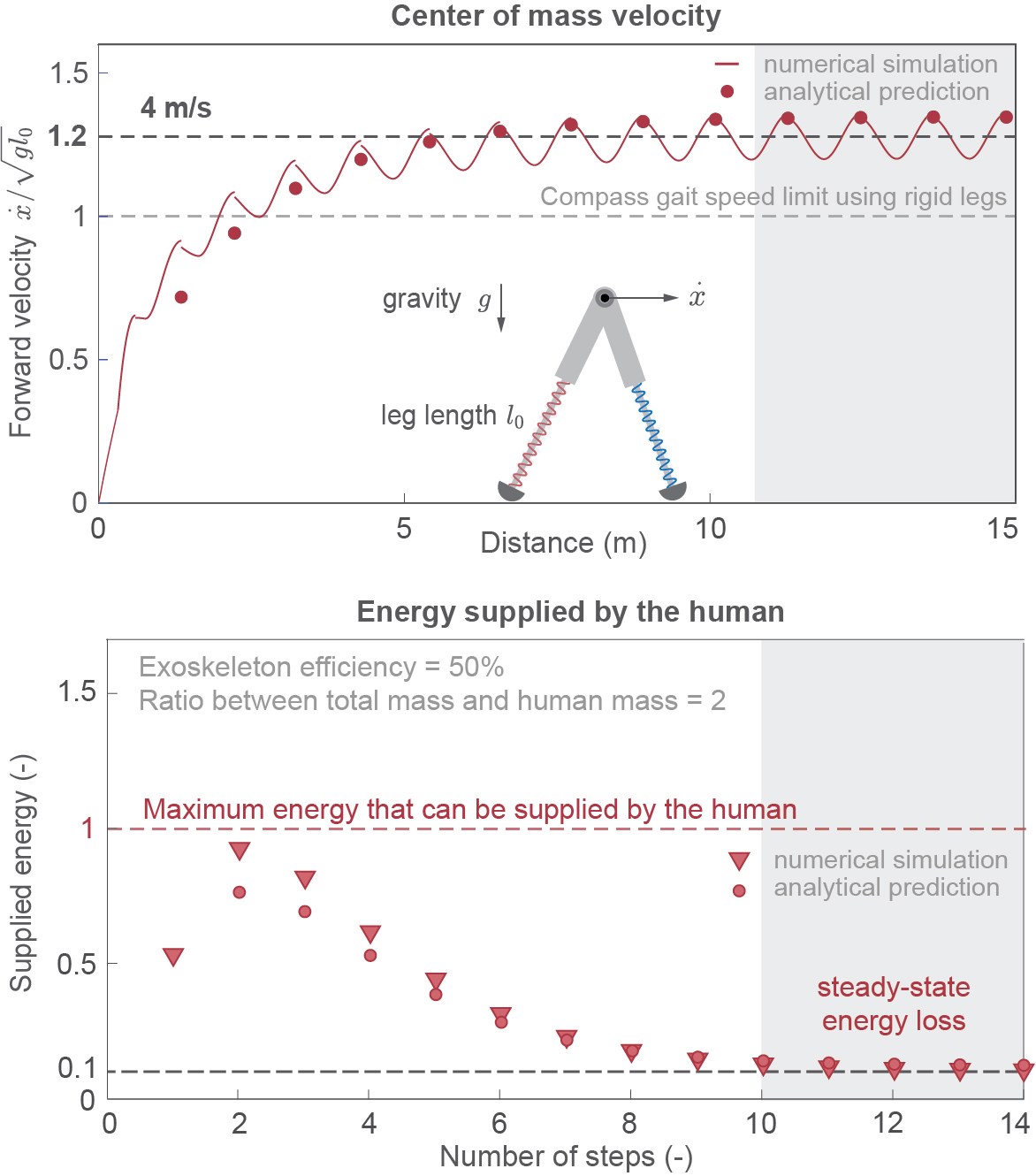
This work establishes the theoretical limits of fast walking with a heavy load in a human-driven robot exoskeleton. The theory predicts that a variable stiffness spring exoskeleton could bring a person carrying one extra body weight to race-walking speed (4 m/s).
- Theory of Fast Walking with Human-Driven Load-Carrying Robot ExoskeletonsT. Zhang and D. J. BraunIEEE Transactions on Neural Systems and Rehabilitation Engineering, vol. 30, pp. 1971–1981, 2022
@article{Zhang2022,
  author  = {T. Zhang and D. J. Braun},
  title   = {Theory of Fast Walking with Human-Driven Load-Carrying Robot Exoskeletons},
  journal = IEEEtnsre,
  volume  = {30},
  pages   = {1971--1981},
  year    = {2022},
  doi     = {10.1109/TNSRE.2022.3190208}
}
Human-driven compliant transmission mechanism
An exoskeleton that works like a bicycle needs a mechanism through which the person can supply energy. This research develops a human-driven compliant transmission mechanism: the person supplies energy while the leg is in the air, the mechanism stores it, and the stored energy is released when the leg is on the ground.
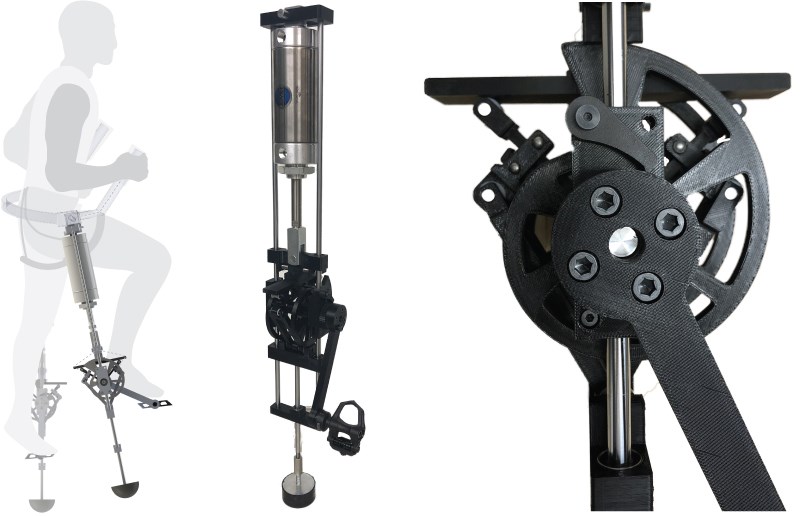
- Human Driven Compliant Transmission MechanismT. Zhang and D. J. BraunIEEE International Conference on Robotics and Automation, pp. 7094–7099, 2021
@inproceedings{Zhang2021conf,
  author    = {T. Zhang and D. J. Braun},
  title     = {Human Driven Compliant Transmission Mechanism},
  booktitle = IEEEicra,
  pages     = {7094--7099},
  address   = {Xi'an, China},
  month     = {May},
  year      = {2021},
  doi       = {10.1109/ICRA48506.2021.9561669}
}
Variable stiffness springs for human augmentation
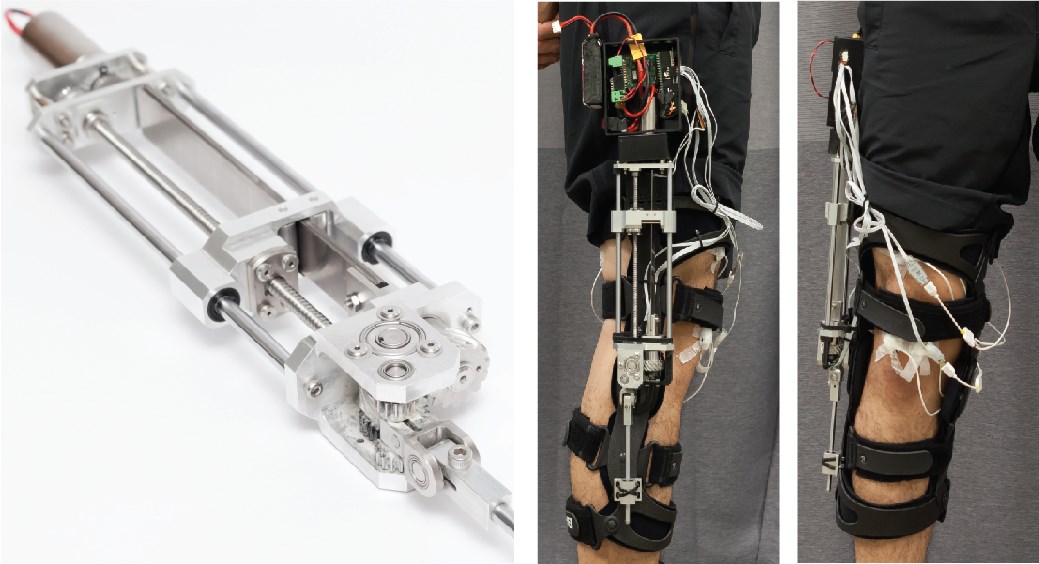
Variable stiffness springs change stiffness at low energy cost, without doing net mechanical work. For human augmentation, they could take over part of the work of opposing muscles that tense together to stiffen a joint, and so reduce muscle activity and metabolic energy cost. In practice, this requires a spring that is compact, lightweight, and portable. The figure below shows one such design.
- Stiffness Modulator: A Novel Actuator for Human AugmentationH. F. Lau, A. Sutrisno, T. H. Chong and D. J. BraunIEEE International Conference on Robotics and Automation, pp. 7742–7748, 2018
@inproceedings{Lau2018conf, author = {H. F. Lau and A. Sutrisno and T. H. Chong and D. J. Braun}, title = {Stiffness Modulator: A Novel Actuator for Human Augmentation}, booktitle = {IEEE International Conference on Robotics and Automation}, pages = {7742--7748}, address = {Brisbane, Australia}, month = {May}, year = {2018}, doi = {10.1109/ICRA.2018.8463186} } - Compliant Actuation for Energy Efficient Impedance ModulationD. J. Braun, S. Apte, O. Adiyatov, A. Dahiya and N. HoganIEEE International Conference on Robotics and Automation, pp. 636–641, 2016
@inproceedings{Braun2016conf,
  author    = {D. J. Braun and S. Apte and O. Adiyatov and A. Dahiya and N. Hogan},
  title     = {Compliant Actuation for Energy Efficient Impedance Modulation},
  booktitle = {IEEE International Conference on Robotics and Automation},
  pages     = {636--641},
  address   = {Stockholm, Sweden},
  month     = {May},
  year      = {2016},
  doi       = {10.1109/ICRA.2016.7487188}
}