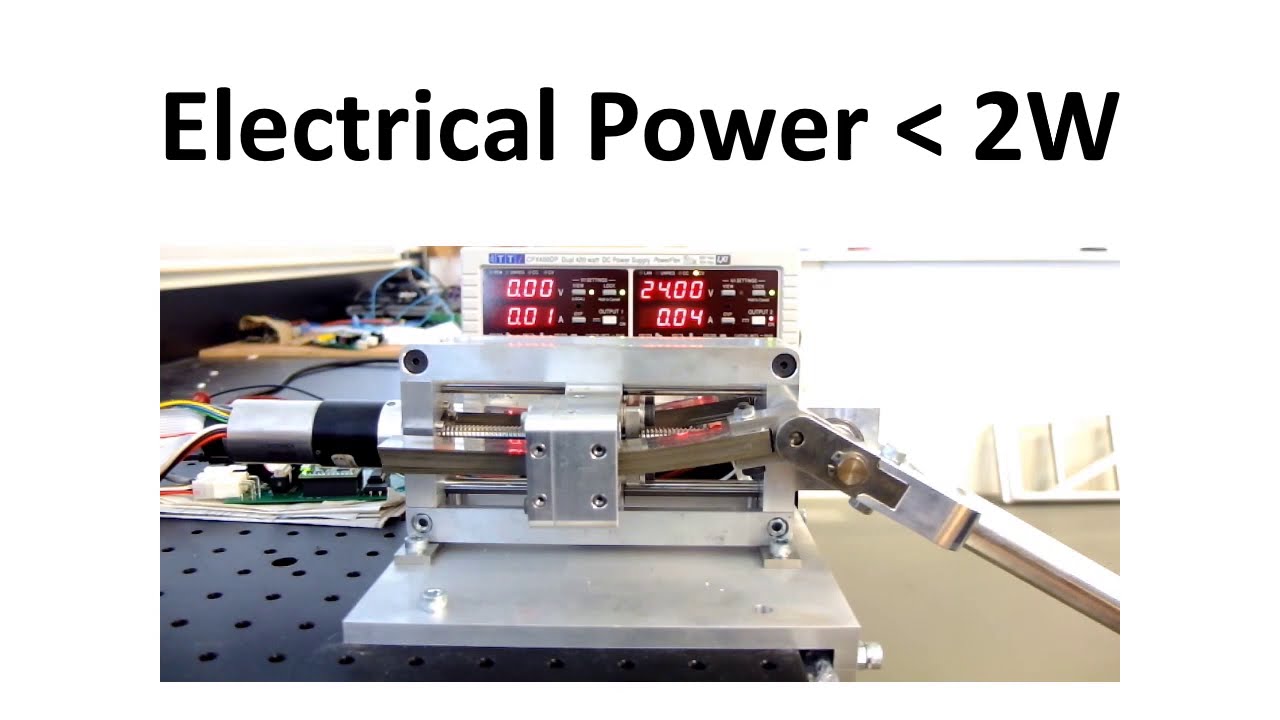
Mechanically adaptive actuators to advance robot autonomy
Actuators are the muscles of a robot. In the human body, muscles work together with tendons, which store and release energy. Compliant actuators bring the same idea to robots: springs are placed in series or in parallel with the motors. The most common types are series elastic actuators (SEAs) and variable stiffness actuators (VSAs). This research develops new types of compliant actuators that adapt their mechanics to the task.
Custom-designed magnetic spring actuators
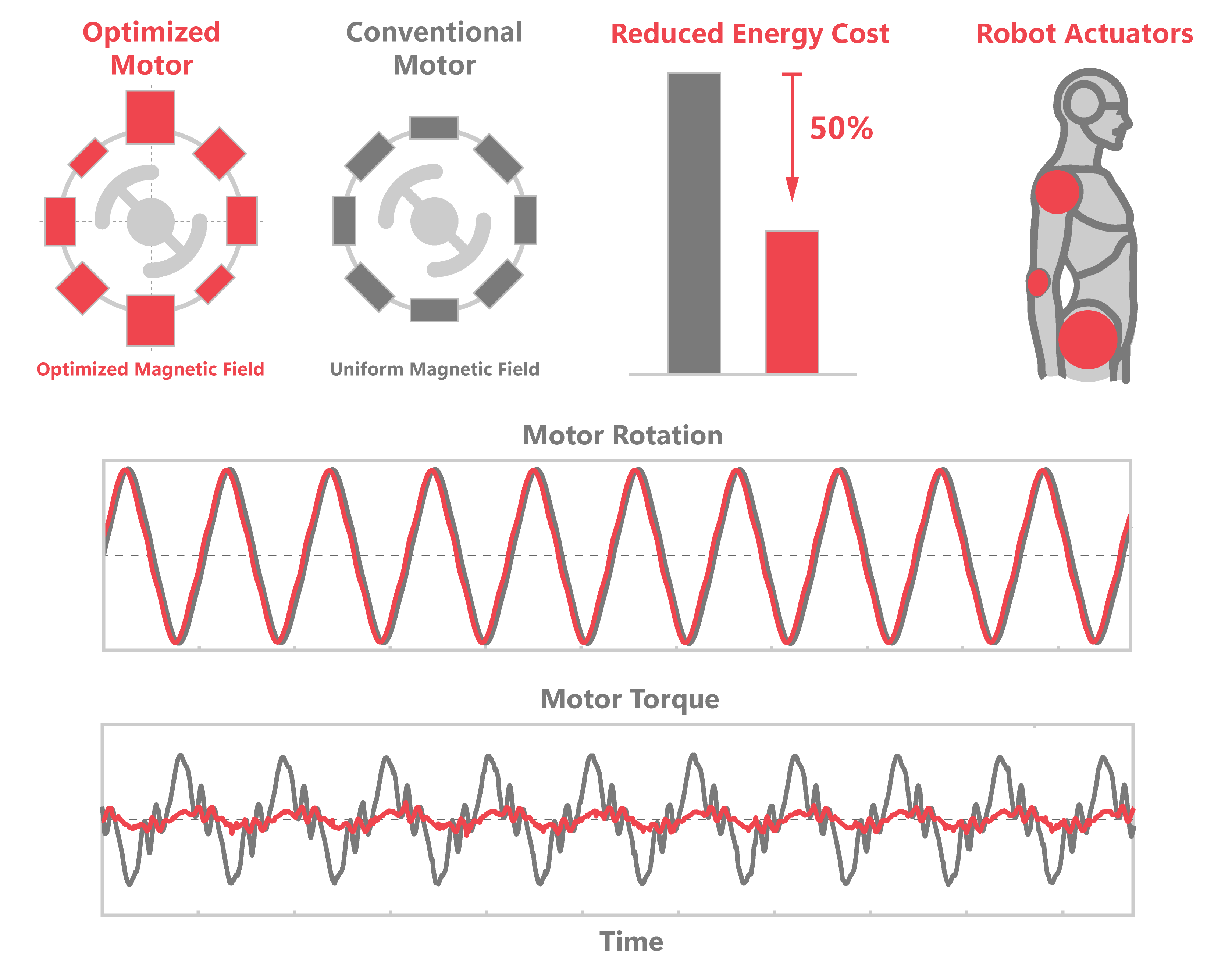
A motor uses energy not only when it does useful work, but also when it holds a position under load or brakes. In repetitive tasks, such as pick-and-place operations or oscillating motions, much of the energy is therefore spent without doing useful work. Magnetic-spring actuators address this problem: the motor is combined with a magnetic spring whose non-uniform magnetic field is designed for one specific task. The spring then supplies much of the torque the task requires, and the motor supplies less. In experiments, energy use fell by up to 50%.
- Energy Minimization using Custom-Designed Magnetic-Spring ActuatorsY. Y. Fu, A. U. Kilic and D. J. BraunIEEE/RSJ International Conference on Intelligent Robots and Systems, pp. 3534–3539, 2024
@inproceedings{Fu2024conf,
  author    = {Y. Y. Fu and A. U. Kilic and D. J. Braun},
  title     = {Energy Minimization using Custom-Designed Magnetic-Spring Actuators},
  booktitle = IEEEiros,
  pages     = {3534--3539},
  address   = {Abu Dhabi, United Arab Emirates},
  month     = {Oct},
  year      = {2024},
  doi       = {10.1109/IROS58592.2024.10802861}
}
Parallel variable stiffness actuators (PVSA)
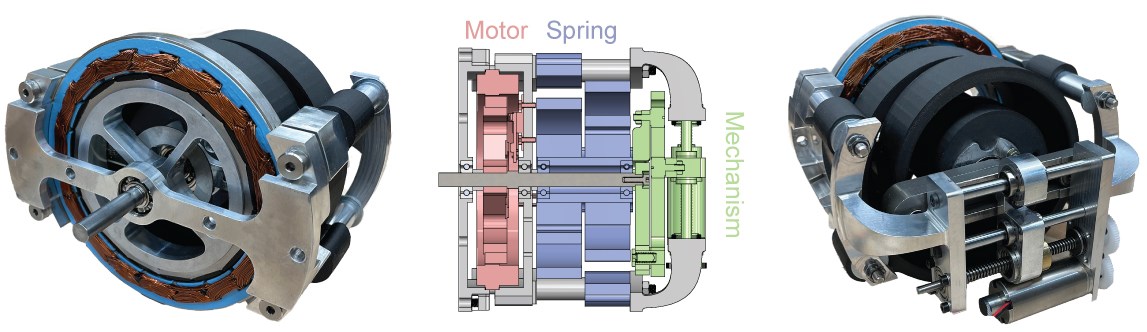
A Parallel Variable Stiffness Actuator (PVSA) places a variable stiffness spring in parallel with a direct-drive motor. It combines the strengths of both: precise force control from the motor and controllable energy storage from the spring. A compact design uses a flat motor connected to a torsional spring with adjustable mechanical advantage. Unlike series elastic and variable stiffness actuators, PVSAs are not subject to a fundamental limit on force control bandwidth. Unlike parallel elastic actuators with fixed stiffness, they can accumulate energy through resonance, even when the deformation of the spring is limited and the motion of the load is constrained. A smaller direct-drive motor combined with a variable stiffness spring can therefore match the peak power of a larger motor without losing force control precision. Possible uses include industrial robots that manipulate precisely and hold weight at zero energy cost, and walking, jumping, running, and swimming robots or exoskeletons that need resonant motion within limited joint ranges.
- Design of Parallel Variable Stiffness ActuatorsC. W. Mathews and D. J. BraunIEEE Transactions on Robotics, vol. 39, no. 1, pp. 768–782, 2023
@article{Mathews2023,
  author  = {C. W. Mathews and D. J. Braun},
  title   = {Design of Parallel Variable Stiffness Actuators},
  journal = IEEEtr,
  volume  = {39},
  number  = {1},
  pages   = {768--782},
  year    = {2023},
  doi     = {10.1109/TRO.2022.3197088}
}
Variable stiffness springs (VSS)
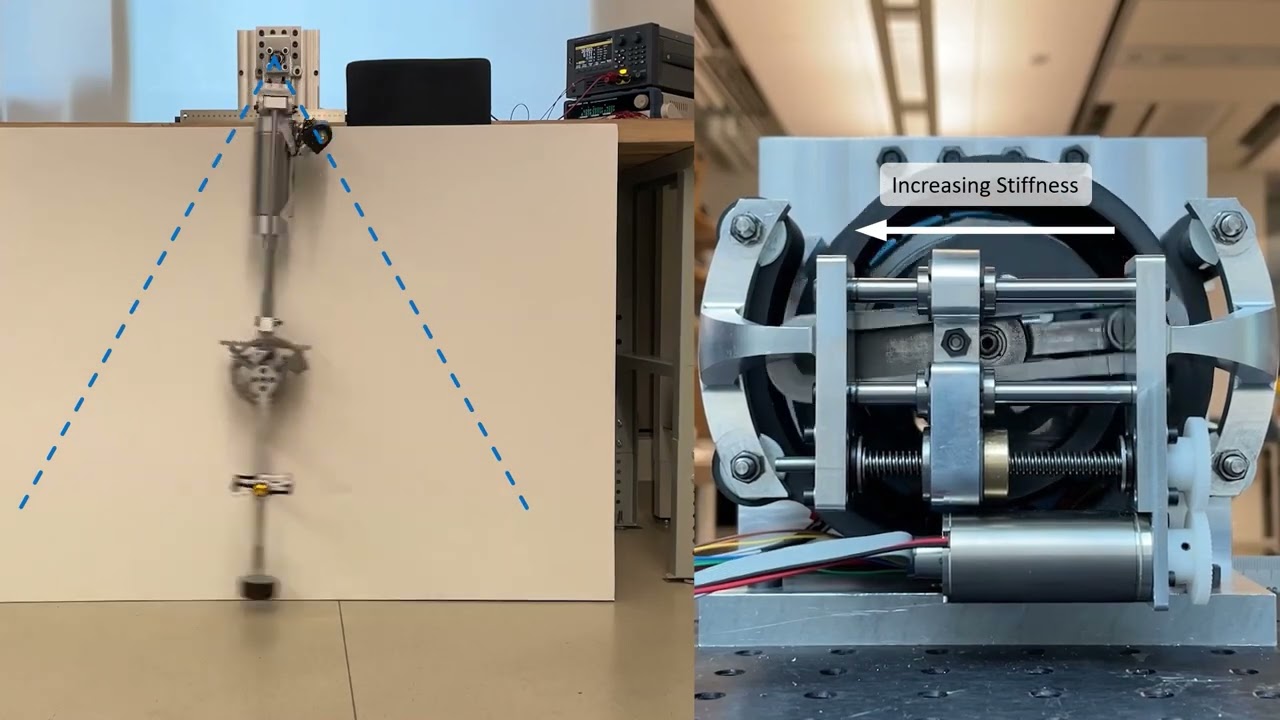
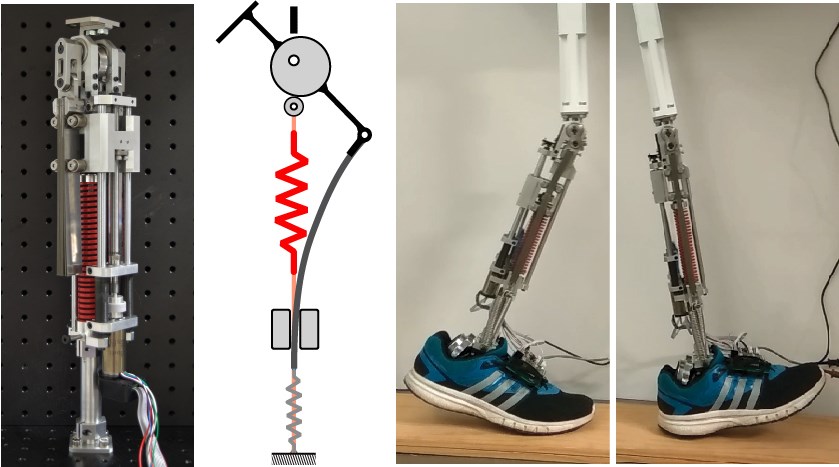
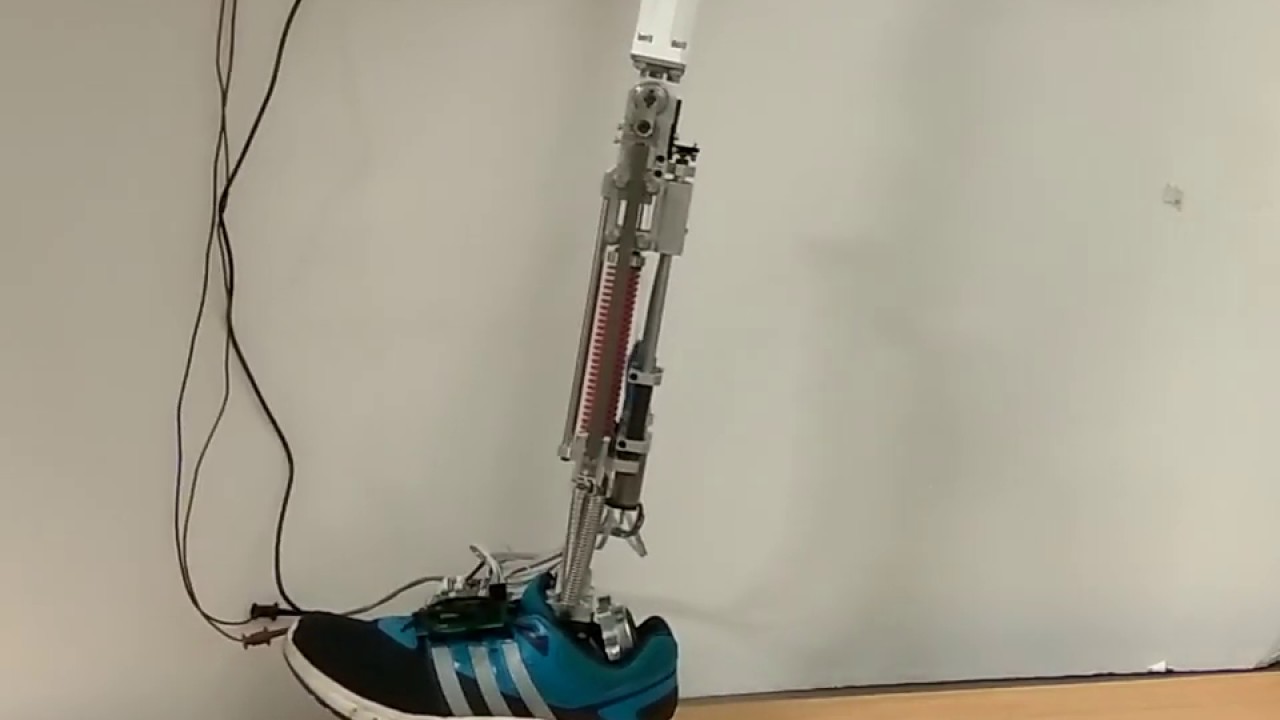
Holding or changing the stiffness of a human joint by tensing opposing muscles costs metabolic energy, even when the muscles do no net mechanical work. A device working in parallel with a human joint could therefore help by supplying stiffness alone. Variable stiffness spring actuators do exactly this. Built around a leaf spring of variable length, the actuator changes stiffness over a large range at low energy cost, even under large deflection, because the force on the driving motor stays low. Unlike variable stiffness actuators, which use two motors to set both stiffness and equilibrium position and to do net mechanical work, it uses a single motor, changes only the stiffness, and does no net mechanical work unless externally loaded. Experiments demonstrated stiffness augmentation during human–machine collaboration in demanding balance and weight-bearing tasks. A device that does little or no mechanical work can therefore still augment the human body, at low energy cost.
- Variable Stiffness Spring Actuators for Low Energy Cost Human AugmentationD. J. Braun, V. Chalvet, T. H. Chong, S. S. Apte and N. HoganIEEE Transactions on Robotics, vol. 35, no. 6, pp. 1435–1449, 2019
@article{Braun2019a,
  author  = {D. J. Braun and V. Chalvet and T. H. Chong and S. S. Apte and N. Hogan},
  title   = {Variable Stiffness Spring Actuators for Low Energy Cost Human Augmentation},
  journal = IEEEtr,
  volume  = {35},
  number  = {6},
  pages   = {1435--1449},
  year    = {2019},
  doi     = {10.1109/TRO.2019.2929686}
}
Positive-negative stiffness actuators (PNSA)
Most compliant actuators have a tunable positive stiffness: they push back when displaced. Changing both the stiffness and the equilibrium position usually requires two motors or closed-loop control. Adding a passive negative stiffness mechanism to a tunable positive stiffness mechanism changes this. The resulting positive-negative stiffness actuator controls both the stiffness and the equilibrium position open-loop, with a single motor.
- Positive-Negative Stiffness ActuatorsD. J. Braun, V. Chalvet and A. DahiyaIEEE Transactions on Robotics, vol. 35, no. 1, pp. 162–173, 2019
@article{Braun2019b,
  author  = {D. J. Braun and V. Chalvet and A. Dahiya},
  title   = {Positive-Negative Stiffness Actuators},
  journal = IEEEtr,
  volume  = {35},
  number  = {1},
  pages   = {162--173},
  year    = {2019},
  doi     = {10.1109/TRO.2018.2872284}
}
Computational design of variable stiffness actuators
Variable stiffness mechanisms have mostly been designed from experience, which limits the designs that can be found. This research turns the design into a mathematical optimization problem. Solving it computationally identifies variable stiffness mechanisms, actuators, and robots that need little power by design.
- Algorithmic Design of Low Power Variable Stiffness MechanismsV. Chalvet and D. J. BraunIEEE Transactions on Robotics, vol. 33, no. 6, pp. 1508–1515, 2017
@article{Chalvet2017a, author = {V. Chalvet and D. J. Braun}, title = {Algorithmic Design of Low Power Variable Stiffness Mechanisms}, journal = IEEEtr, volume = {33}, number = {6}, pages = {1508--1515}, year = {2017}, doi = {10.1109/TRO.2017.2719049} } - Criterion for the Design of Low Power Variable Stiffness MechanismsV. Chalvet and D. J. BraunIEEE Transactions on Robotics, vol. 33, no. 4, pp. 1002–1010, 2017
@article{Chalvet2017b,
  author  = {V. Chalvet and D. J. Braun},
  title   = {Criterion for the Design of Low Power Variable Stiffness Mechanisms},
  journal = IEEEtr,
  volume  = {33},
  number  = {4},
  pages   = {1002--1010},
  year    = {2017},
  doi     = {10.1109/TRO.2017.2689068}
}