Reverse-engineering nature for locomotion control in robots
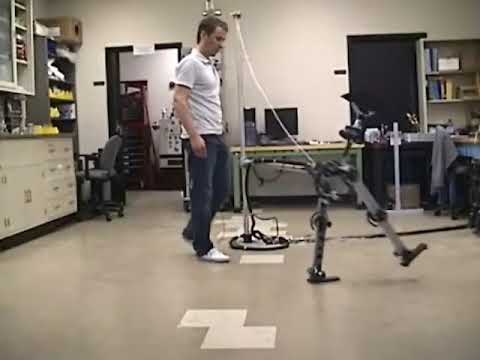
Walking looks effortless, yet every step requires the nervous system to coordinate the legs and keep the body balanced at the same time. Understanding how humans do this is a first step toward robots that assist and augment people, such as exoskeletons for rescue operations or for people whose walking is impaired by illness or injury. This research develops simplified models of the biological controller behind human walking, and uses them to control walking robots and assistive devices.
Reverse-engineering impedance controllers from human locomotion data
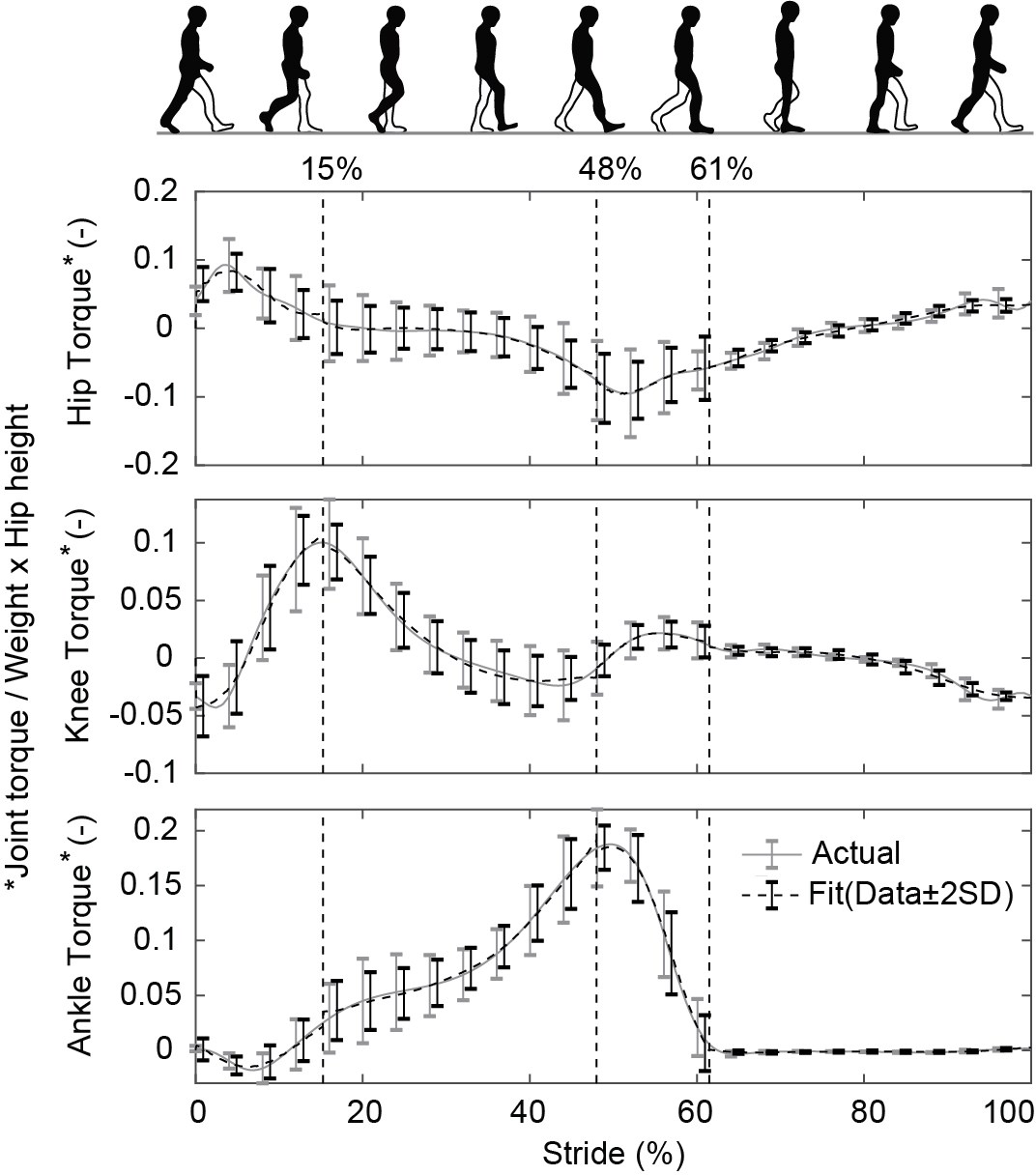
Human walking data contain a hidden relation between the joint torques, angles, and velocities. This research asks whether a small number of linear controllers, applied one after another, can recover that relation. Using the walking data of seven healthy subjects, four multivariable linear controllers approximate the relation well, each active in one of the four phases of the gait cycle, separated by toe-off and heel-strike. This multiphase, multivariable controller generalizes earlier multiphase single-variable controllers and single-phase multivariable controllers. It explains the walking data of multiple subjects better, and it generalizes better to new subjects. The result supports moving from decoupled single-joint controllers to coupled multi-joint controllers, for walking robots as well as for assistive and augmentation devices.
- Multiphase and Multivariable Linear Controllers that Account for the Joint Torques in Normal Human WalkingE. S. Altinkaynak, G. Roig and D. J. BraunIEEE Transactions on Biomedical Engineering, vol. 67, no. 6, pp. 1573–1584, 2020
@article{Altinkaynak2020,
  author  = {E. S. Altinkaynak and G. Roig and D. J. Braun},
  title   = {Multiphase and Multivariable Linear Controllers that Account for the Joint Torques in Normal Human Walking},
  journal = IEEEtbe,
  volume  = {67},
  number  = {6},
  pages   = {1573--1584},
  year    = {2020},
  doi     = {10.1109/TBME.2019.2940241}
}
Switching impedance control for legged locomotion
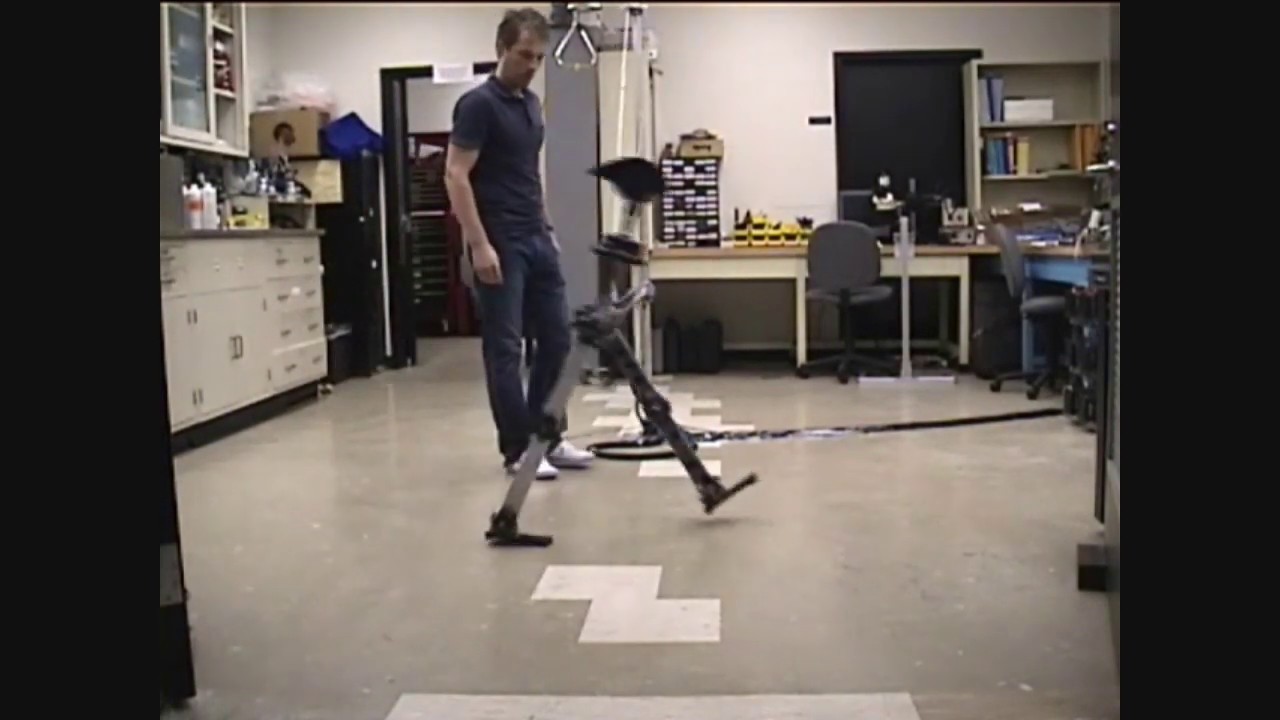
Prosthetic legs often coordinate the limb with single-joint switching impedance controllers. This research tested whether an optimization-based generalization of these controllers can solve the full coordination problem of walking on two legs: not only coordinating the limbs, but also stabilizing the upper body of a walking robot. Numerical simulations and experiments on an anthropomorphic biped robot strongly support this.
- Actuated Dynamic Walking in a Seven-Link Biped RobotD. J. Braun, J. E. Mitchell and M. GoldfarbIEEE/ASME Transactions on Mechatronics, vol. 17, no. 1, pp. 147–156, 2012
@article{Braun2012d, author = {D. J. Braun and J. E. Mitchell and M. Goldfarb}, title = {Actuated Dynamic Walking in a Seven-Link Biped Robot}, journal = IEEEtmech, volume = {17}, number = {1}, pages = {147--156}, year = {2012}, doi = {10.1109/TMECH.2010.2090891} } - A Control Approach for Actuated Dynamic Walking in Biped RobotsD. J. Braun and M. GoldfarbIEEE Transactions on Robotics, vol. 25, no. 6, pp. 1292–1303, 2009
@article{Braun2009,
  author  = {D. J. Braun and M. Goldfarb},
  title   = {A Control Approach for Actuated Dynamic Walking in Biped Robots},
  journal = IEEEtr,
  volume  = {25},
  number  = {6},
  pages   = {1292--1303},
  year    = {2009},
  doi     = {10.1109/TRO.2009.2028762}
}