Optimal control of compliant robots: IEEE T-RO Best Paper Award
Stiff and soft at the right moment
A person throwing a ball does not simply push harder. The arm stays loose during the wind-up and tightens at the right moment, so muscles and tendons store energy and release it into the throw. Robots driven by compliant actuators can work the same way: springs inside the actuators store energy, and variable impedance actuators can change their stiffness while the robot moves. The difficulty is control. These actuators are nonlinear and have hard limits on range, speed, and force, so deciding how torque and stiffness should change during a fast motion is a difficult problem.
Optimal control under physical limits
The key achievement of the award-winning paper is safe optimal control under actuation constraints. The method computes the torque and the stiffness of each actuator together, over the whole motion, while keeping every actuator within its limits on range, speed, and force. The robot can therefore move fast without exceeding what the hardware can safely deliver.
The torque and stiffness profiles are computed in advance, so the control appears to be feedforward. How, then, can a complex robot move reliably when no model is exact? The answer lies in the actuators. A spring between the motor and the joint acts as feedback built into the hardware: when the joint deviates from the planned motion, the spring pushes it back, much like a proportional–derivative (PD) controller, but without sensors or computational delay affecting joint stability. The stiffness plays the role of the feedback gain. Optimizing the stiffness profile therefore means optimizing the feedback gains over the whole motion. This built-in feedback is also why the transfer from simulation to the real robot took only two weeks.
What the research has shown
- Safe control under constraints: simulations and hardware experiments showed that the method keeps fast motions within the limits of real actuators, and how these limits change the best motion.
- Torque and stiffness, optimized together: changing the stiffness during the motion, within the limits of real actuators, improved task performance in experiments.
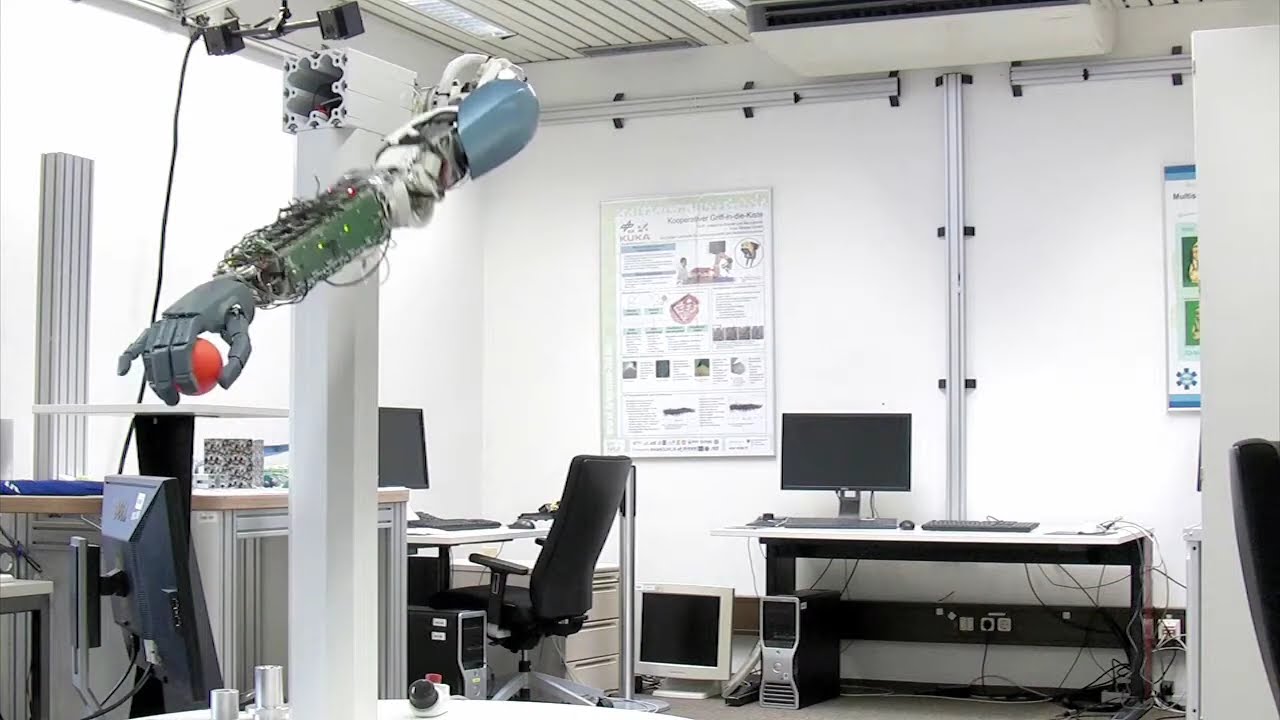
- From simulation to hardware in two weeks: on the DLR Hand Arm System, a humanoid arm now called David, the method produced a dynamic ball throw from optimization alone, without human demonstrations. The transfer from simulation to the real robot took two weeks, with only two days of work on the hardware.
Recognition
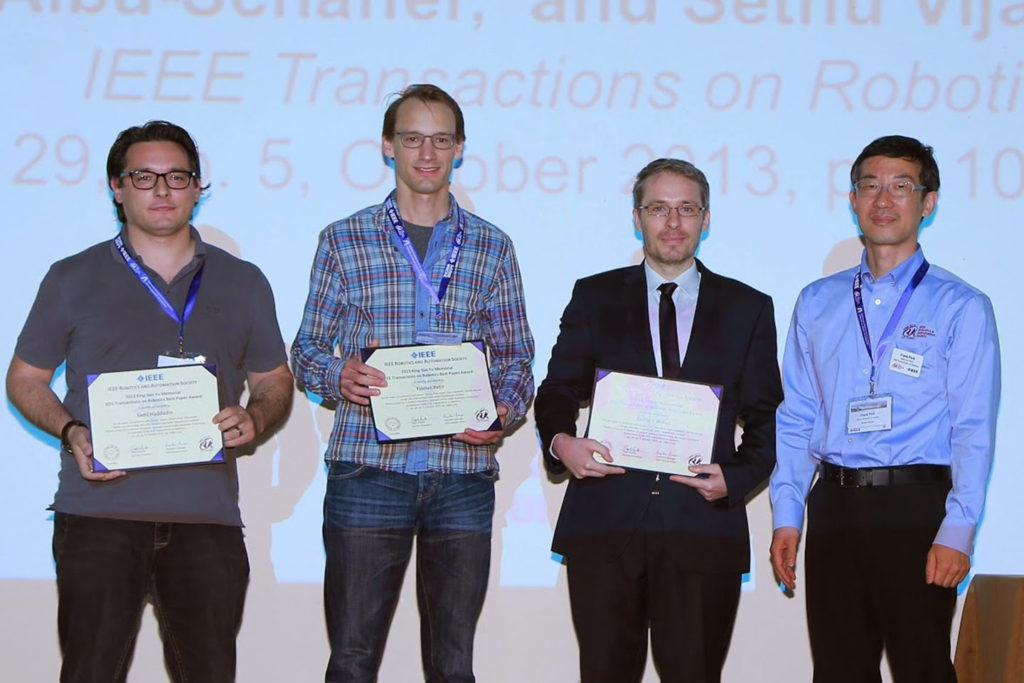
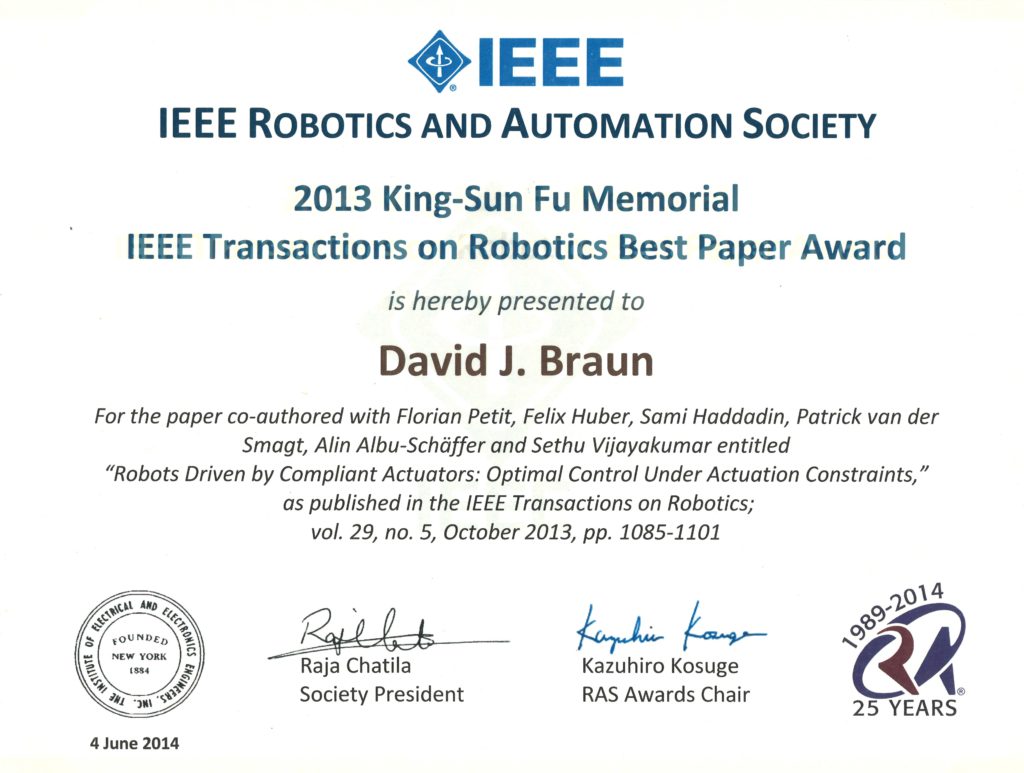
The paper received the 2013 King-Sun Fu Memorial IEEE Transactions on Robotics Best Paper Award, given each year to the best paper published in IEEE Transactions on Robotics. The award was presented at ICRA 2014 in Hong Kong.
Where it led
The idea of working with springs rather than against them runs through later research: programmable springs that change stiffness at near-zero energy cost, and optimal control by experiment, which closes the sim-to-real gap on the real machine.