
T. Zhang and D.J. Braun, Theory of Fast Walking With Human-Driven Load-Carrying Robot Exoskeletons, Transactions on Neural Systems and Rehabilitation Engineering, vol. 30, pp. 1971-1981, 2022.
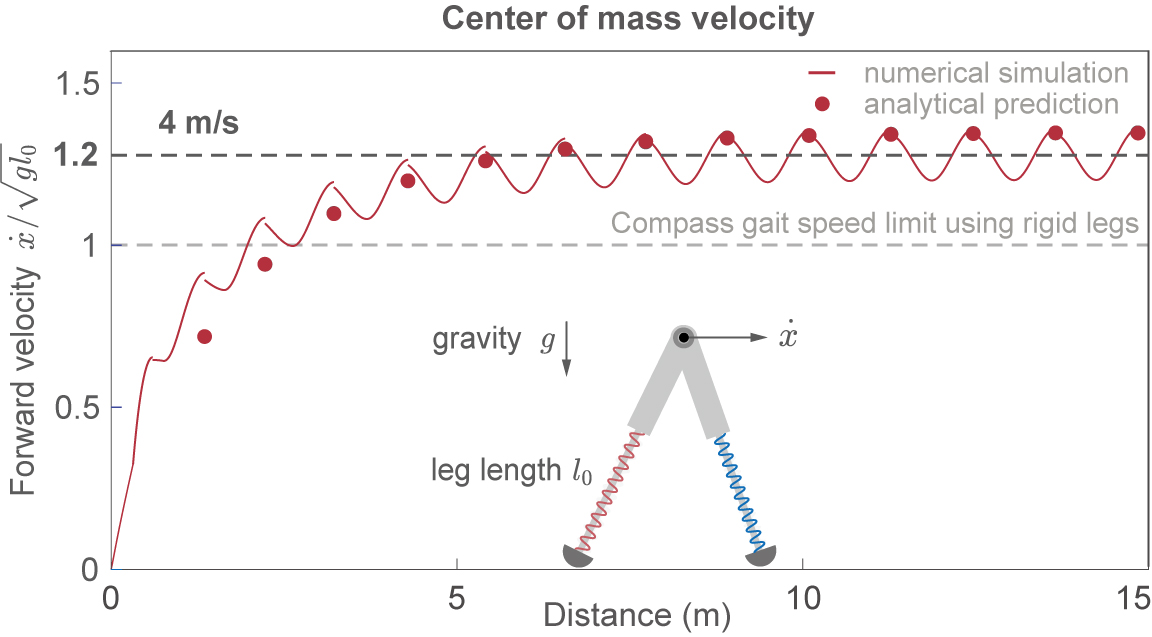
This paper develops the theory of a mechanically adaptive, spring-based robot exoskeleton designed to help humans walk faster while carrying heavy loads. By adapting limb stiffness, the exoskeleton can shift the mechanics of walking toward bicycle-like motion, enabling faster acceleration and higher sustained speeds than humans can achieve alone. The study shows that such an exoskeleton could accelerate the equivalent of an additional body weight to top race-walking speed within ten steps, without requiring external energy.
Why it matters: Carrying heavy loads slows humans down and increases fatigue. A human-driven exoskeleton with adaptive springs could extend weight-bearing and fast-walking capabilities while remaining energy-efficient, with potential applications in rehabilitation, defense, and industry.